This simple tool makes your night photos look amazing
Get longer exposure times in your Milky Way photos without blurring the stars.
I recently got the NOMAD Star Tracker from Move Shoot Move.
Here's an overview of how I use it.
I get everything set up on my tripod, the tracker, the polar alignment laser, as well as my ball head before leaving home.
When I get to the scene, I manually focus by hand-holding my camera.
I attach the camera to the ball head, which is on the tracker.
I rough out my composition.
I move the camera out of the way.
Then I use the laser to align with Polaris, the North Star.
I put the camera back into position.
I double check my composition.
I take a photo.
I check my focus and exposure, and shoot my images.
Repeat for every time you move your camera to a new location.
A star tracker follows the rotation of the Earth so that when you're shooting stars, you can use longer exposures and you won't get motion blur from the star trails. With longer exposures your ISO can stay low, which results in less noise.
Your signal is higher when you have more time in your exposure, but you want to keep the noise down. A star tracker allows you to do that because it moves with the rotation of the earth. And that's the crux of it.

Milky Way over the Mossleigh, Alberta, Grain Elevators
Gear I used to shoot the astro photos
LUMIX S1 Mark II
LUMIX 18 mm f1.8 lens
Leofoto LH30 Ballhead
Tripod
At first the tracker looks a bit daunting to set up. But even if you're a beginner, you don't have to be scared about using a tracker. I'd never used one before and I had really good results my first night out with it.
I've made videos in the past about simple astro setups. All you need is a wide-angle lens and your micro four thirds or your full-frame camera. Don't even wait to buy an a tracker. Just get going.
The Move, Shoot, Move Nomad makes it really easy.
They have a bunch of kits and combos to choose from. And at the very least, you want to get the tracker and the polar align laser. That's all I use from the kit I have.
You will also need a ball head and also another tripod head. MSM has a kit that includes a ball head. I would recommend getting that unless you have a spare ball head to use.
Keep in mind in some parts of the world, the lasers like this are illegal to use. So, make sure you check your local laws for that. If you can't use the laser pointer, then you need to use your phone as a alignment tool.
Charge the tracker with its USB-C port. There's an on and off switch. One is for Southern hemisphere and one is for Northern hemisphere.
Use my Coupon Code: imagemaven
For 5% off anything from the MSM website.
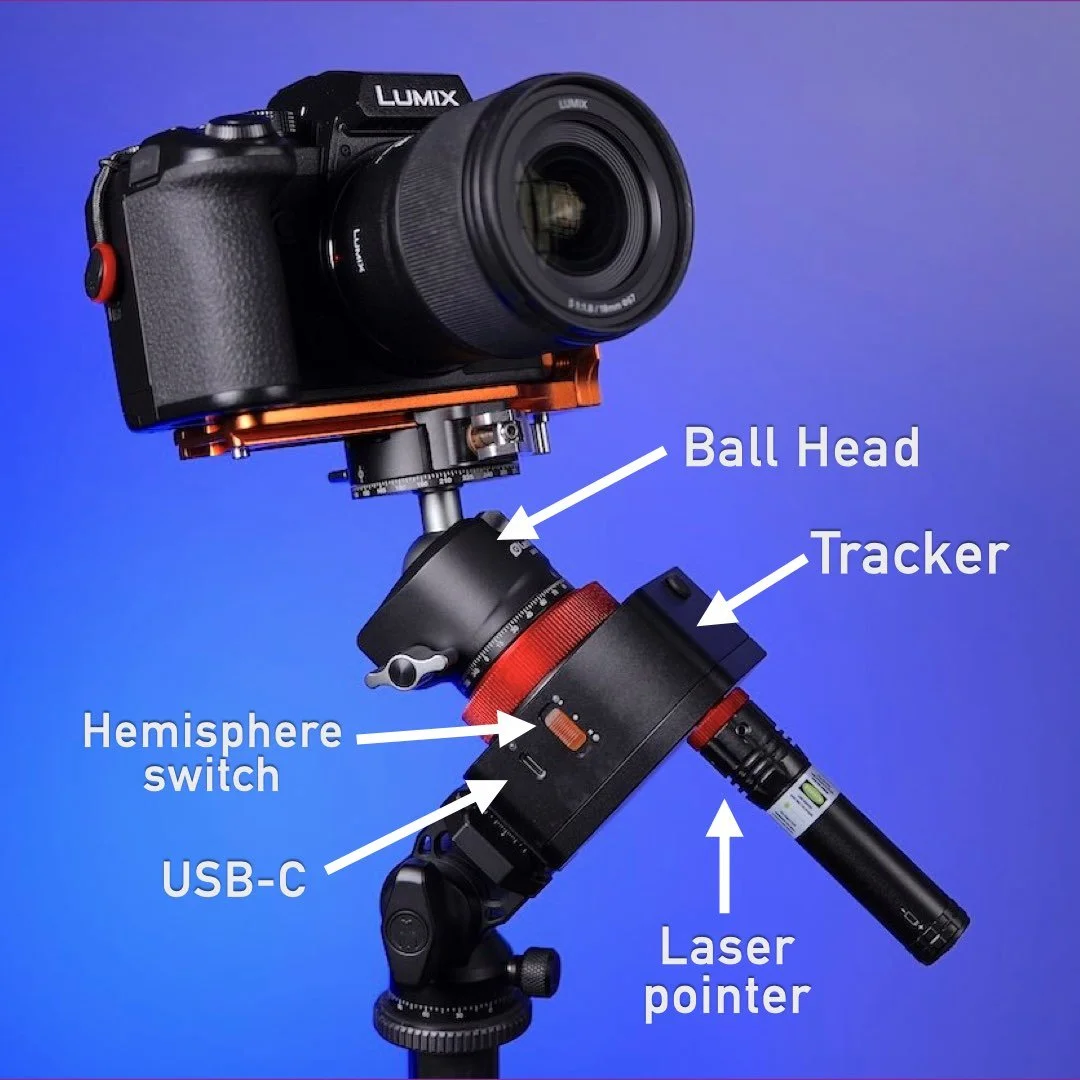
NOMAD Star Tracker set up with the camera and laser pointer attached
Tips
Once you align your tracker, turn it on right away, even before you start shooting. Earth rotates faster than you realize, and you will soon get out of alignment.
Assemble everything before you leave the house, except for the camera. But have your lens on the camera and dial in your starting settings (ISO, WB, shutter speed, f/stop). I put everything together, and I even put it on the tripod legs before leaving the house. And once I get to my location, I put the camera on. I locate the North Star (Polaris) and then I start shooting because otherwise you're fumbling in the dark. So, you want to have as little to do as possible once you're on location.
When I'm focusing on the stars, of course, I use manual focus, but I prefer to handhold my camera when doing so. And the reason for that is when things are assembled onto the tracker or even onto your tripod, sometimes things are at weird angles and I find it hard to get my eye onto the eyepiece when I'm manually focusing. And if you think about it, stars are a million miles away. So moving your camera around a few feet either way isn't going to affect focus when something's that far away. Once you are in focus, do not touch your focus ring. And sometimes that's hard. So just remember that if you accidentally bump your camera or move it when you're putting it back onto your tracker setup, you might have to redo your focus. And of course, always take some test shots to confirm that your stars are in focus.
I highly recommend that you set everything up ahead of time, ballpark the composition you want to shoot, and then do the polar alignment because you cannot move anything once you're aligned.
Composition first - Move camera out of the way
Polar alignment
Test shots
Adjust exposure
Shoot a few compositions in each spot
Move tripod to new location: Repeat steps 1-5
Now, if you don't have a tracker yet, I urge you to get out and shoot anyway.
You can do time lapse videos internally in your LUMIX camera. You can also do live view composite without having to edit hundreds of photos on the computer. And you can do aurora photos. You don’t need a tracker for those things.
There are fun beginner things to try for astrophotography, even if you don't have a tracker. So, get out and shoot something. You’ll soon be hooked!
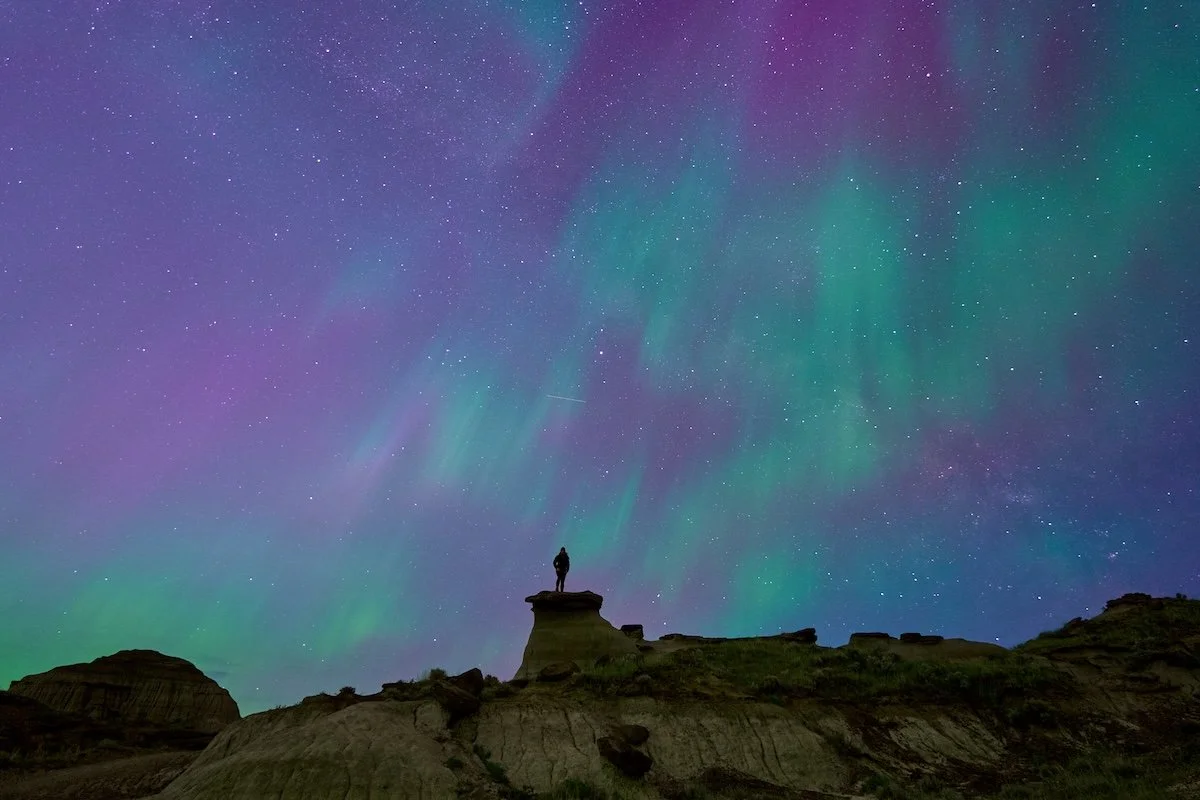
Aurora Borealis - Dinosaur Provincial Park Alberta